

Introduction
Nearly 50% of PhD students drop out after reaching the dissertation phase, according to 2024 data from the National Science Foundation. That statistic is terrifying. When you hit the dissertation stage, you stop taking classes and start sitting alone in a room with a blank document. Suddenly, crippling writer's block and procrastination take over. You go from being a top-tier student to feeling like an absolute fraud.
In my office hours, I see the same look of panic every single week. Students tell me it is more pleasurable to bang their foreheads against the university walls than struggle to get their master's thesis done. I have been there myself. The gap between knowing your research inside your head and actually articulating it on paper feels impossible to cross. You sit at your laptop, type a sentence, delete it, and then spend two hours organizing your citation software instead of actually writing.
This guide will show you exactly how to write a thesis without losing your mind. Instead of generic advice about working hard or waking up early, we will focus on the actual, psychological strategies that get words on the page. We will cover how to structure your arguments efficiently, how to intentionally write terrible first drafts simply to build momentum, and how to survive the inevitable mid-project slump that derails so many academics.
Most academic guides just list the chapters you need to write. We combine hard statistics on graduate attrition with actionable, stage-by-stage writing methods to ensure you cross the finish line with your sanity intact.
What is a Thesis (And What is it Not)?
A thesis is a substantial academic document submitted for a university degree that presents original research and defends a specific knowledge claim. It is not just an oversized book report or an exhausted summary of existing literature. It requires you to articulate a unique position, carve out a gap in current research, and support your stance meticulously with evidence gathered through organized study.
The word itself comes from the ancient Greek term "thésis," which literally means "something put forth." You are putting forth a proposition, planting a flag in the academic ground, and daring your examiners to examine it. Your goal is to prove that your methodology is sound and your conclusions are valid.
Why does this matter so much? Because a thesis proves you can conduct structured research under pressure. It is the ultimate test of your ability to manage a massive, self-directed project. But this is exactly where the trouble starts for perfectly intelligent people.
Most textbooks stop at the formal format definition, but the reality of writing a thesis is much messier. The primary distinction between a standard college paper and a thesis is the expectation of new knowledge. You are supposed to add something fresh to the conversation. This expectation paralyzes people. A 2023 Academic Writing Difficulty Study found that 70.59% of students find academic papers hard to write, with a significant portion viewing them as extremely difficult. Add in the fact that a 2023 ACT National Student Readiness Report found over 65% of students do not meet benchmark scores for basic English Language Arts. If basic writing is a struggle nationwide, it is no wonder that graduate-level synthesis causes complete burnout.
Students think they need to be absolute geniuses to write a thesis, so they freeze. They end up in what experts call the muddle of the middle.
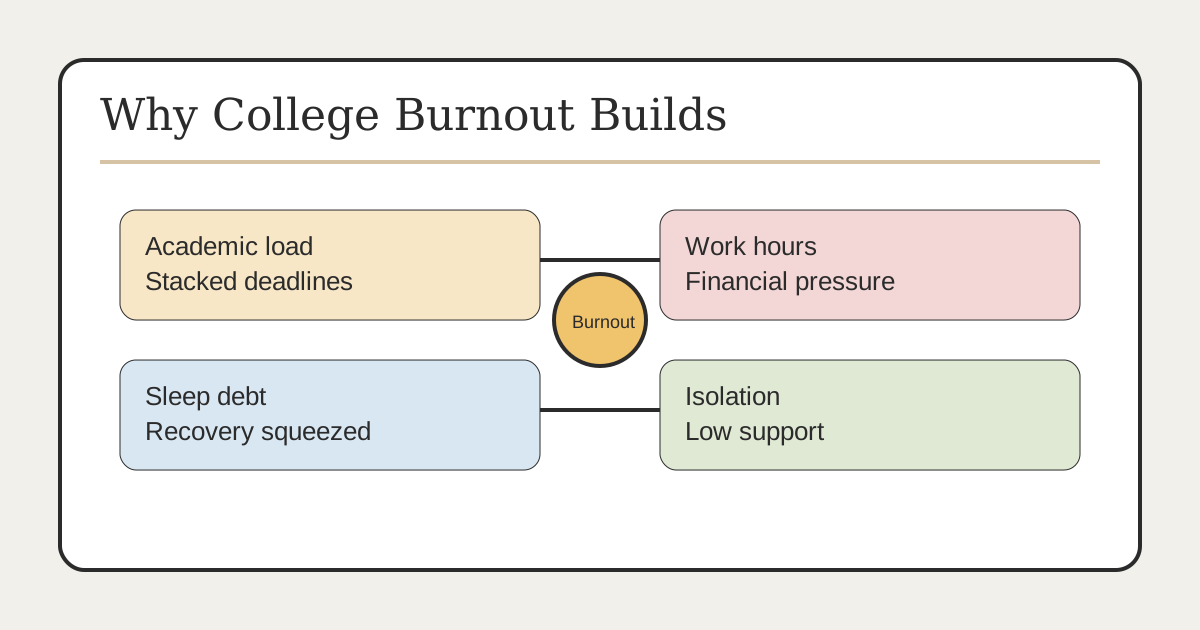
Professor Inger Mewburn, the Director of Researcher Development at the Australian National University, puts it perfectly: "The middle phase of a thesis can be particularly challenging and boring. You need to name this feeling to tame it." You will inevitably hit a wall where you hate your topic, doubt your methodology, and want to quit. That is not a sign of failure. It is a mandatory, predictable part of the process.
You have to stop thinking of your thesis as a single, monumental document that must be flawless from day one. It is a living, breathing draft that you will tear apart and rebuild multiple times. The sooner you accept that the first version will be terrible, the faster you will actually finish it.
The Brutal History of the Academic Thesis
To understand why thesis writing feels like mental torture, you have to look at its origins. The concept started with ancient Greek philosophers like Plato and Aristotle in the Athenian academic circles. Back then, a thesis was a purely verbal proposition. You made a claim in front of a hostile audience of your peers and literally verbally sparred to defend it. The goal was to poke holes in each other's logic until only the strongest ideas survived.
When the first formal universities were established in the 12th and 13th centuries across Europe, this process evolved into the "disputatio." Scholars were expected to stand publicly in the town square or the university hall and defend their ideas against all challengers. Think of Martin Luther nailing his 95 Theses to the door of the Wittenberg Castle church in 1517. That was not just an act of religious rebellion. It was a standard, recognized academic challenge, an invitation for a public, intellectual fight among scholars.
Over the centuries, as the printing press democratized text, academia shifted slowly from oral debates to written documentation. The physical dissertation became the standard proof of expertise for obtaining a PhD. But the underlying DNA of the thesis has not changed at all. It is still designed to be an adversarial defense of your ideas. Your committee members are simply playing the modern roles of those ancient, hostile challengers.
Today, the format is highly standardized, but the pressure has only magnified. We are seeing major shifts in how students engage with and survive this process. For instance, data from Universities Australia shows that domestic PhD completions jumped 41% between 2000 and 2023. At the same time, the demands on graduate students have skyrocketed. You are no longer just writing a document. You are managing massive datasets, formatting strict layouts, handling complex citation software, and navigating a brutal academic job market simultaneously.
Why do you need to know this history? Because it puts your current, perfectly normal anxiety into perspective. The thesis process was literally engineered to be difficult and to rigorously test your capacity to withstand criticism. When your advisor aggressively tears apart your literature review, they are participating in a tradition that goes back almost a thousand years.
By recognizing that the friction is a required feature and not a bug, you can stop taking the struggle personally. You can view the endless revisions as a mechanical, necessary sharpening of your argument rather than a devastating personal attack on your intelligence or worth.
Step 1: Ditch the Linear Structure (And Plan Backwards)
Most students open a blank document, type 'Chapter 1: Introduction,' and proceed to stare at the screen until their eyes bleed. This is exactly how you fail. The concept of linear writing—starting at the beginning and writing chronologically to the end—makes sense for a novel. It is absolute poison for a research thesis.
A thesis is not a story; it is a defense of a claim. So why would you write the introduction before you even know exactly what your final results and conclusions will be? You cannot introduce a guest who hasn't arrived at the party yet.
Instead, we use a non-linear approach. The basic premise is skipping the hardest parts (Introduction, Discussion) until the very end, and starting with the easiest, most factual chunks. A 2023 study from Aalto University confirmed this, finding strong positive associations between organized, non-linear approaches to writing and significantly higher thesis grades.
| Aspect | Linear Writing | Non-Linear Writing (Recommended) |
|---|---|---|
| Key Focus | Chronological flow (Intro → Lit Review → Methods → Results) | Momentum-based flow (Methods → Results → Lit Review → Intro) |
| Best For | Fiction novels, short blog posts, narrative essays | Complex academic theses, data-heavy research, dissertations |
| Limitations | Causes severe writer's block; forces you to write intro without knowing the ending | Requires meticulous file organization and an outline to stitch together later |
| Example Application | Writing an autobiography | Writing a 100-page master's thesis |
This organized methodology starts with your Methods chapter. Why? Because you already know what you did. You do not have to invent anything or analyze deep thematic shifts. You just write down the steps you took to gather your data. From there, you move to your Results, then carefully construct your Literature Review around the specific findings you ended up with, completely ignoring the literature that turned out to be irrelevant. Finally, you write the Introduction and Abstract last.
How do I choose a research topic that aligns with my interests?
Students ask me this constantly, usually while pitching broad, world-changing ideas. Here is the harsh truth: choose a topic based on exact available resources and strict word counts rather than just burning passion. If you pick a massive, fascinating topic but cannot access the data, you will fail. Narrow the scope until it feels almost uncomfortably specific. A thesis on 'The History of European Politics' is a doomed ten-year project. A thesis on 'Jeroen Spieker's 2024 EPS award-winning analysis of Centre-Right Parties' Approach to Immigration' is actually achievable.
Step 2: Pushing Through Writer's Block with 'Trash' Drafts
Crippling writer's block is not a sign that you are not smart enough for academia. It is a sign that your internal editor is overpowering your internal writer. A massive 2023 Academic Writing Difficulty Study published on ResearchGate confirms this: 70.59% of students find academic papers hard to write. You are not alone; you are just fighting the wrong battle.
The solution is brutally simple: you must intentionally write 'trash' first drafts.
Conventional wisdom says you should outline carefully and draft sentences that are at least coherent. Frankly, most textbooks get this wrong. That approach triggers perfectionism. The goal of a first draft is purely word count on a page. It doesn't matter if you write, "The data shows that [insert smart thing here later because I can't remember the exact number]." That is a successful drafting session.
How do I overcome writer's block and procrastination?
You overcome it by completely separating the act of writing from the act of editing. When you draft, you are laying bricks. When you edit, you are aligning the wall. You cannot do both simultaneously. Embrace producing 'trash'. If you get stuck, literally write "I am stuck here because I don't know how to transition from the survey data to the interview quotes, but anyway, moving on to..." Just keep the fingers moving.
Step 3: Conquering the 'Muddle of the Middle'
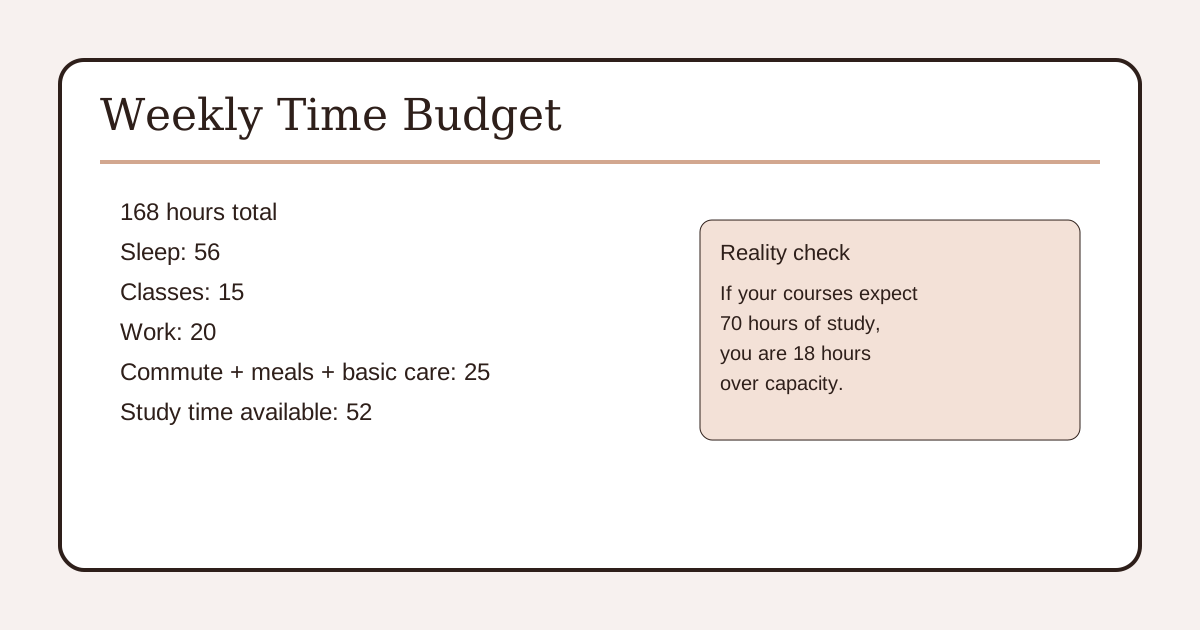
There is a specific, soul-crushing phase of every long-term project. The initial excitement has worn off, but the finish line is weeks or months away. Professor Inger Mewburn accurately labels this the "muddle of the middle." Your motivation dies, the data looks boring, and you start questioning your life choices.
What should I do when I completely lose motivation?
When you completely lose motivation in the mid-thesis slump, do not rely on sheer willpower. Instead, use a brilliant academic survival tactic called Structured Procrastination. This term was coined by Stanford philosopher John Perry.
Perry realized that procrastinators rarely do absolutely nothing. They avoid the main, scary task by doing a million smaller, less important tasks. He notoriously gained a reputation as a terrific Resident Fellow at Stanford not because he loved the job, but because playing ping-pong with students was a great way to avoid reading dissertation drafts.
You can hack this psychological quirk. When you absolutely cannot stomach writing your discussion chapter, don't go watch Netflix. Procrastinate by doing other necessary thesis tasks. Format your bibliography. Organize your reference management software. Tweak the formatting of your charts. Read that one adjacent research paper you bookmarked last week.
You are still procrastinating on the terrifying main objective, but you are moving the project forward. Keep a 'secondary task' list specifically for the days when writing is impossible.
Step 4: Surviving the Discussion Chapter and Revisions
The Discussion chapter is where most students panic. Up until this point, you have been reporting what other people said (Literature Review) and what you did (Methods/Results). But the Discussion requires you to stick your neck out and make new knowledge claims. This causes massive impostor syndrome.
We see this anxiety in the research. A 2024 study by Universitas Kristen Duta Wacana confirmed that learners experience moderate to high levels of anxiety specifically concerning how they express their arguments and language. It is terrifying to hand a messy, poorly worded draft to a highly credentialed professor.
How can I easily deal with the anxiety of sharing my messy drafts?
Understand your advisor's actual job description. Their job is not to be amazed by your genius first draft. Their job is to find the flaws in your logic and help you fix them. If you hand them a perfect draft, they are completely useless.
You have to reframe vulnerability as necessary iteration. Treat your advisor's feedback as a mechanical punch-list, not a personal attack on your intelligence. When they cover your draft in red ink, they are basically telling you exactly what the examiners will flag during your defense. They are giving you the cheat code to pass.
Furthermore, do not fall into the trap of endless revisions. Keep your eye on the objective: graduating. The Stanford University PhD Completion Report noted that only 63.2% of doctoral students graduate within six years or less. A massive reason for delayed graduation is students refusing to submit work because it isn't 'perfect' yet. Let go of the masterpiece complex. The best thesis is a finished thesis.
How to Actually Apply The 'Trash Draft' Method
Now that you understand the psychology of structural planning and structured procrastination, here is how you actually apply it to your writing schedule. Knowing the theory is useless if you sit down and still stare blankly at a blinking cursor.
The first strategy you need to adopt is the "Snowball Method" for your literature review. Do not try to read every paper on academic databases. Instead, find the one, most highly cited paper that perfectly captures your core thesis argument. Read it thoroughly, then immediately look at its bibliography. The authors have already curated the best sources for you. Track those citations backward to build your foundation, and use a tool like Google Scholar's "Cited By" feature to track them forward for the most recent updates.
When it comes to drafting the actual document, use the "Zero-Drafting" technique. Before you start a Pomodoro cycle, write a three-bullet outline of exactly what that specific 25-minute sprint needs to cover. Just three bullet points. Then, expand those bullets without stopping.
The 4 Deadliest Thesis Mistakes (And Why Students Fail)
You can follow every piece of advice in this guide and still fail if you fall into the classic traps that derail even the best graduate students. By analyzing Reddit forums like r/GradSchool and consulting academic failure data, we see the same four catastrophic mistakes repeated constantly.
1. Working in Total Isolation. Students try to complete the demanding process completely alone, without seeking support from peers or faculty. This happens because of ego; you think asking for help proves you aren't smart enough to be in the program. To avoid this, force yourself to create a weekly check-in schedule with your advisor or a writing group. A thesis cannot survive in a vacuum.
2. An Unclear or Shifting Research Question. You start with a question, but mid-way through data collection, you find something "more interesting" and try to pivot. This results in a thesis that is unfocused and collapses under its own weight. A thesis is not an exploration; it is a targeted strike. Let the "interesting" tangential data become a separate paper published later. Keep your current paper laser-focused.
3. The Endless Literature Trap. Students will spend six months reading and highlighting PDFs because reading feels like making progress, while writing feels like taking a risk. This is a severe form of procrastination. Put a hard cap on your literature review phase. Read to answer your specific question, and then stop.
4. Writing to Sound "Smart." Students try to elevate their prose with dense, convoluted academic jargon, assuming it sounds more rigorous. In reality, examiners hate grading unreadable fluff. A good thesis uses simple, direct language to explain complex ideas. If your sentence needs to be read three times to be understood, it is a bad sentence.
Essential Software and Thesis Survival Resources
You should not be manually formatting bibliographies or trying to track 300 PDFs in desktop folders in 2026. Use the tools designed to automate the misery out of this process.
For research management, adopt a specialized citation manager immediately. Zotero and Mendeley are industry standards, and they are largely free. For drafting, consider distraction-free text editors or Scrivener, which allows you to move chunks of text (like your Methods and Results) around seamlessly, adhering to the non-linear writing philosophy.
If you need credible statistical data or baseline definitions, lean strictly on `.edu` and `.gov` sources. The National Center for Science and Engineering Statistics (NCSES) via the NSF is the gold standard for tracking graduation rates and demographic data. For literature searches, beyond Google Scholar, utilize JSTOR and your university's proprietary library access.
If you are trapped in the "muddle of the middle" and cannot find a way out, our Academic Strategy team at Take My Class offers targeted, expert interventions to unblock your thesis and get you back on a graduation timeline.
Final Thoughts: Lower Your Standards and Graduate
You started this guide faced with the terrifying reality that nearly 50% of PhD students drop out during the dissertation phase. Now you have the exact psychological and structural tools to ensure you cross the finish line.
- Stop trying to write chronologically; start with methods and results.
- Silence your internal editor and embrace the "trash draft."
- Use structured procrastination to keep momentum during the mid-project slump.
- Treat your advisor's ruthless edits as mechanical fixes, not character assassinations.
- Avoid isolation and the endless literature review trap.
The academic job market for doctoral graduates remains incredibly strong. The Bureau of Labor Statistics continues to track significant wage premiums for doctoral degrees—with Computer and Information Systems Managers alone projecting a median salary near $169,510. The financial and professional payoff is massive, but only if you actually finish.
You have got this. Your thesis does not have to be a masterpiece; it just has to be a completed document that defends your methods. Here is your next step: Tonight, set a timer for 25 minutes and write the most painfully bad, unedited paragraph you have ever produced. Just get words on the page.
And if you hit a wall you simply cannot climb over alone, let our Academic Strategy experts guide you through the revisions.
![How to Write an English Literature Essay [2026]](system/images/thumbnails/english-literature-essay.svg)
![ProfHacker for Students: Productivity Tools Guide [2026]](system/images/thumbnails/profhacker-for-students-productivity-tools.svg)
![The Research Whisperer: Research Success Guide [2026]](system/images/thumbnails/the-research-whisperer.svg)