
Introduction
Between 2012 and 2024, the number of English bachelor's degrees awarded in the United States fell 43%, according to the American Academy of Arts and Sciences. That number should scare you a little. Not because English is dying, but because the students who stay in the major face stiffer competition every year. Your essays need to do more than pass. They need to stand out.
Here's what I see in office hours, about three times a week: a student staring at a blank Google Doc, convinced they're bad at analysis. They're not. They just haven't finished Beloved yet. Or they read it in one panicked sitting and retained nothing useful. One student on The Student Room put it bluntly: "I procrastinate because I think that if I don't read the WHOLE BOOK in one sitting there's no point in even starting." I hear that logic constantly. It's wrong, and it costs grades.
This guide starts where SparkNotes stops. You'll get a reading triage system for impossible syllabi, a thesis formula that survives professor scrutiny, and body-paragraph models showing exactly how quote analysis earns marks. I've graded over 2,500 undergraduate literature essays. Frankly, most guides skip the reading problem entirely. This one doesn't.
What Is an English Literature Essay?
An English literature essay is a formal argument about how a literary text creates meaning, supported by close reading and embedded quotations. You state a debatable thesis, prove it in body paragraphs using textual evidence, and avoid plot summary. Strong essays analyze language, structure, and form rather than retelling what happens.
That's the short answer Google wants. Now the longer one, because the short answer alone won't save your grade.
A literature essay is not a book report. It's not a review where you say whether you liked the novel. And it's definitely not a personal diary entry about how a character reminded you of your ex. Gerald Graff, co-author of They Say / I Say and professor emeritus at the University of Illinois at Chicago, frames it this way: academic writing is a conversation. When you write a literary analysis, you enter a dialogue with scholars who interpreted this text before you. Your job is not to retell the story. Your job is to add something new to that conversation.
Most college essays follow a structure your professor expects even if they never spell it out. Introduction with a clear thesis. Three or four body paragraphs, each making one claim that supports that thesis. A conclusion that synthesizes your argument instead of repeating it. The Bucks County Community College writing center puts it simply: every paragraph must grow out of your central idea and contribute to the reader's understanding of it. Stray plot summary doesn't do that. Analysis does.
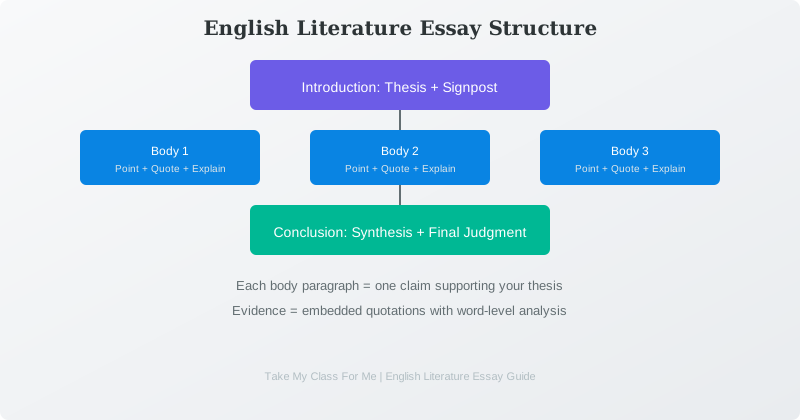
So how do you actually write one? These five steps are the workflow I'll walk you through in this guide:
- Triage your reading list by checking which texts appear in lecture slides and tutorial questions.
- Close read and annotate key passages, building a bank of short quotations tagged by theme.
- Build a debatable thesis using the Observation + Analysis + Significance formula.
- Write body paragraphs with the introduce-quote-explain pattern (sometimes called PEEL).
- Revise ruthlessly to cut plot summary and strengthen word-level quote analysis.
College-level essays typically use MLA citation format for both in-text citations and your Works Cited page. If your professor specifies Chicago or APA, follow their syllabus. But MLA is the default in most English departments.
Why Your Reading Strategy Matters More Than Your Outline
Most essay guides assume you've already read the book. That's a fantasy. A first-year student on The Student Room described getting a reading list on Monday with three full novels due that same week, one per module. "I've never been so overwhelmed in my life," they wrote. I believe them. I've watched it happen across fourteen years of teaching.
Here's my contrarian take: bad literature essays usually start with bad reading, not bad writing. You can outline perfectly and still produce a C paper if your evidence pool is thin because you never engaged with the text. Queen's University's Student Academic Success Services warns that plot summary is the most common trap in literature papers. But plot summary is often a symptom. You summarize when you don't have analytical notes to draw from.
The historical roots of close reading explain why professors care so much. In 1924, Cambridge instructor I.A. Richards published Principles of Literary Criticism, arguing that literary study should focus on the text itself, not the author's biography or your gut reaction. His 1929 book Practical Criticism turned classroom poetry exercises into a method that shaped American literary education for decades. Cleanth Brooks and Robert Penn Warren brought those techniques to U.S. classrooms through their 1938 textbook Understanding Poetry. When your professor asks you to analyze word choice in a single stanza, you're standing on a century of academic tradition.
That tradition collides with a messy present. The National Assessment Governing Board reported in 2024 that only 35% of U.S. 12th graders were academically ready for entry-level college reading coursework, down from 37% in 2019. Meanwhile, fall 2023 saw roughly 1.59 million undergraduate enrollments in English courses across American departments, yet over 40% of English department chairs told the American Academy of Arts and Sciences that undergraduate numbers had declined over the prior three years. In the UK, English degree enrollments dropped 19% between 2019-20 and 2023-24. More students in the classroom, fewer majors committing long-term, and many arriving underprepared for the reading load.
A University Times student essay captured the emotional cost: "Never did I imagine myself plagued by reading burnout: the stress of constantly feeling behind as the reading flow refuses to ever stop or slow down." If that sounds familiar, you're not lazy. You're drowning in volume. And waiting until you've read everything before you start your essay outline is a recipe for a blank document and a panicked all-nighter.
You don't need to read every page of every assigned book to write a strong essay. You need to read the right pages strategically, annotate them properly, and turn those notes into evidence. The next section shows you how.
Step 1: Triage Your Reading List (Before You Panic)
You do not need to read every page of every assigned book to write a strong English literature essay. You need to read the right pages. That distinction saves grades every semester.
A student on The Student Room described the first-year reality bluntly: three books per week, one per module, with the reading list arriving days after the week had already started. Another admitted, "I procrastinate because I think that if I don't read the WHOLE BOOK in one sitting there's no point in even starting." I see that logic in office hours constantly. It produces blank documents and panicked all-nighters.
Here's the system I teach. Every Monday, spend ten minutes sorting that week's readings into three tiers before you open a single book.
Tier 1 (load-bearing): Texts named in lecture slides, tutorial discussion questions, or your assignment brief. Read these fully. Annotate as you go. These are non-negotiable.
Tier 2 (skim smart): Secondary criticism on JSTOR, readings mentioned once in passing, or background chapters your professor called "helpful but not required." Read the abstract, introduction, and conclusion. Skim for one usable idea you can steal and apply to a different passage.
Tier 3 (skip for now): Anything that appears in zero lectures, zero tutorials, and zero assessments all semester. Skip it on purpose. The University of Melbourne study skills team makes the same point quietly: reading lists mix essential and supplementary material, and professors expect you to be selective.
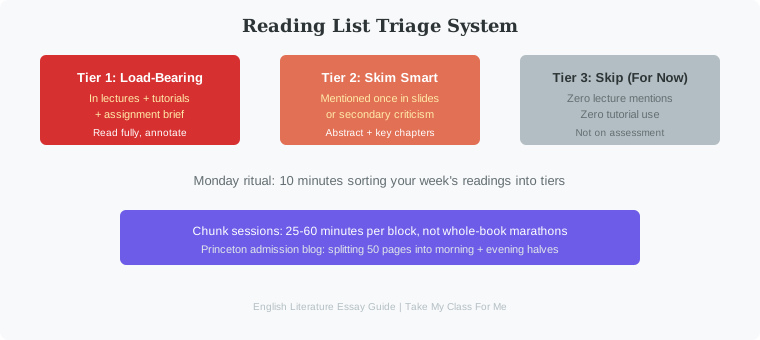
Chunk your Tier 1 reading into 25-to-60-minute blocks instead of whole-book marathons. A Princeton admissions blog on reading-intensive concentrations recommends splitting fifty pages across morning and evening sessions. Same pages. Less cognitive fatigue. And if you're genuinely behind on a novel, pick three passages at random (avoiding the most obvious ones), read those closely, and build your essay around what you found. A former Student Room user claimed they earned a 2:1 across two years of English by reading "the very bare minimum" and focusing analysis on obscure passages. I'm not endorsing that as a lifestyle. But it proves the point: targeted reading beats guilty avoidance.
Step 2: Close Read and Build Your Evidence Bank
What Is Close Reading?
Close reading means reading a literary text slowly and repeatedly to examine how specific word choices, images, sound patterns, and structural decisions create meaning. You annotate key passages, ask questions about the author's craft, and collect short quotations that will become evidence in your essay.
That's the definition. Here's why it works. A 2023 study by Breukink, van der Knaap, and van den Bergh in L1-Educational Studies in Language and Literature found that students who practiced deep reading processes over six weeks improved poetry comprehension with an effect size of .81 and short story comprehension at .66. A separate pilot study by Ferreira and colleagues at the University of Porto, published in Anglo Saxonica, showed that university students trained in close reading and close writing produced significantly higher structural complexity in narrative analysis, with gains maintained at follow-up.
Frankly, most students think close reading means reading slowly. It doesn't. It means reading with a question. The San Jose State University writing center teaches an explication chain: observe form, note effect, then connect to meaning. A metaphor isn't evidence until you explain what it does in that specific sentence.
Build your evidence bank as you read. Aim for 8 to 12 short passages tagged by theme. Each entry needs three things: the quote (under four lines), the page or line number, and a one-sentence note about why it might matter. Erniwati's 2023 study of 98 English education students at Tadulako University found that figurative language and sound device analysis were among the eight most common comprehension difficulties. Your annotation checklist should target exactly those pain points: diction, imagery, tone, structure, point of view, and sound patterns in poetry.
How to Analyze a Poem for Your Essay
Poetry essays fail when students treat the poem like a short story with line breaks. Take Shakespeare's Sonnet 18 ("Shall I compare thee to a summer's day?"). You don't need the whole sonnet memorized. You need one quatrain with line numbers cited properly.
Read the opening line for sound: the soft "th" alliteration in "thou" and "thee" against the harder consonants in "summer." Ask what that contrast sets up before you reach the volta in line 9. Poetry grading rubrics reward line-level precision. Prose grading rubrics reward paragraph-level argument. Adjust accordingly.
Step 3: Write a Debatable Thesis Statement
Your thesis is the spine of the essay. Everything else hangs on it. Weak thesis, weak paper. No amount of pretty vocabulary fixes that.
Coalinga College's writing guide offers a formula that actually works in my grading: Observation + Analysis + Significance. You notice a pattern in the text. You argue what that pattern means. You explain why a reader should care.
Start with a generative question before you commit. Not "What happens in Macbeth?" but "How does Shakespeare use natural imagery to frame Macbeth's moral collapse?" Turn the answer into your thesis.
Compare weak and strong versions for a Macbeth ambition prompt:
- Weak: "This essay will discuss Macbeth's ambition and how it leads to his downfall."
- Strong: "Shakespeare tracks Macbeth's ambition through a shift from natural to unnatural imagery, suggesting that moral order in the play is not destroyed by ambition alone but by Macbeth's willingness to rupture the symbolic boundary between the two realms."
And for a Beloved memory prompt:
- Weak: "Beloved is about trauma and memory."
- Strong: "Morrison uses fragmented chronology and embodied haunting to argue that memory in Beloved is not passive recall but a physical force that reshapes the present lives of survivors."
The W.W. Norton writing guide puts it well: a good thesis enables the reader to enter the essay with a clear sense of what you will prove. It also makes promises your body paragraphs must keep. Before you finalize, check: can you support this claim with at least three distinct textual moments? Could a reasonable person disagree? If both answers aren't yes, keep refining.
Step 4: Structure Body Paragraphs That Earn Marks
Body paragraphs are where grades are won or lost. I've read thousands that open strong and fall apart here. The pattern is almost always the same: plot summary dressed up with a quotation dropped in the middle like a decorative sticker.
Use PEEL: Point, Evidence, Explanation, Link. Your topic sentence states a claim that supports the thesis. Evidence is a short embedded quote. Explanation is two to four sentences analyzing specific words. Link connects back to your central argument or sets up the next paragraph.

The Introduce-Quote-Explain Pattern
Here's what a professor-grade paragraph looks like for The Great Gatsby. The claim: Fitzgerald uses the green light to represent deferred longing rather than achievable desire.
Point: Fitzgerald frames Gatsby's longing as permanently deferred, not merely blocked by circumstance.
Evidence: When Nick observes that Gatsby "stretched out his arms toward the dark water in a curious way," the reaching gesture positions desire as directional but unreachable (Fitzgerald 25).
Explain: The adjective "curious" distances Nick from Gatsby's intensity, while "dark water" turns the bay into a barrier rather than a pathway. Gatsby reaches toward something visible but structurally inaccessible. The light across the water glows, but the water itself does not move.
Link: This spatial frustration sets up the novel's broader argument that the American Dream survives as image, not outcome.
Notice the ratio. The quote is one sentence. The analysis is three. The Brandeis University writing program recommends that your analysis be at least as long as the quotation itself. Penn English department guidelines agree: weave short quotes into your own sentences rather than dropping them standalone.
How to Embed Quotes Without Quote-Dumping
Quote-dumping looks like this: "Gatsby believed in the green light. 'Gatsby believed in the green light, the orgastic future that year by year recedes before us.' This shows his hope." That second sentence is a dead fish on the page, as George Mason literature professor Teresa Michals puts it. You dropped the quote without framing it.
Fixed version: "Fitzgerald presents Gatsby's faith as temporally doomed when Nick describes 'the orgastic future that year by year recedes before us,' a syntax that turns aspiration into a backward-moving horizon rather than a forward path (Fitzgerald 189)."
When should you use a block quote instead? The University of Wisconsin-Madison writing center and most MLA guides say block format applies to quotations of four or more lines of prose. Everything shorter gets embedded with quotation marks inside your own sentence. Use present tense for analysis: "Gatsby reaches," not "Gatsby reached."
| Aspect | Embedded Quote | Block Quote |
|---|---|---|
| Length | Fewer than 4 lines of prose | 4+ lines of prose |
| Format | Inside your sentence with quotation marks | Indented, no quotation marks |
| Best for | Word-level analysis of a phrase | Examining sustained passage rhythm |
| Common mistake | Dropping quote without lead-in | Using block format to pad word count |
| Professor preference | Default choice for most body paragraphs | Use sparingly, only when necessary |
Write in present tense when discussing literary texts. Say "Steinbeck presents Curley's wife as isolated," not "Steinbeck presented." You're analyzing a living text, not reporting historical events. And treat characters as constructions, not real people. Weak: "Curley's wife is lonely." Strong: "Steinbeck positions Curley's wife as a figure denied individual naming, signaling her structural marginalization within the ranch's social order."
Step 5: Write Your Introduction and Conclusion
You've built your evidence bank and drafted body paragraphs. Now wrap the argument. And here's the counterintuitive part: write your introduction last.
I tell students this every semester and they resist it. But you cannot signpost an argument you haven't written yet. Draft your body paragraphs first, then craft an introduction that previews the claims you actually made. The UNC Writing Center introduction guide agrees: address the question, state your thesis, and outline your approach. Keep it concise. That's it.
Introduction formula: One or two sentences of context (author, text, situation). Your thesis statement. A brief signpost of your three main claims. Do not spend half a page on Shakespeare's biography. Your professor has read Hamlet. They have not read your specific argument about it.
Conclusion formula: Start with your analytical payoff, not the words "in conclusion." Synthesize how your body paragraphs collectively prove the thesis. Offer a final judgment about the text's broader significance. Do not introduce new evidence or a new thesis in the last paragraph. The University of Zurich Literature Guide warns that secondary sources should support your voice, not replace it. The same rule applies to conclusions: your argument, not a Wikipedia summary.
For timed exams, use the SQ3R method (Survey, Question, Read, Recite, Review) during your initial reading pass so you arrive at the essay portion with a mental map of key passages. For take-home papers, block ninety minutes for body drafting, thirty for introduction and conclusion, and thirty for revision. That ratio prevents the common trap of perfecting paragraph one while leaving no time for paragraph four.
Apply the Cornell Note-Taking Method during close reading: a narrow left column for keywords and questions, a wide right column for quotes and observations, and a summary row at the bottom of each page tying passages to potential thesis claims. When essay day arrives, you're not starting from scratch. You're translating notes into PEEL paragraphs.
7 Common Mistakes That Cost You Marks
Most literature essays don't fail because the student is unintelligent. They fail because of fixable patterns repeated every assignment. The University of Toronto writing centre puts it plainly: the main purpose of an English paper is to advance an argument, not recount the narrative. Here are the seven mistakes I mark down most often.
Mistake 1: Plot summary instead of argument. Students describe what happens because it's easier than explaining why it matters. A grader on College Informations put it simply: "Most graders already know the plot. They are looking for interpretation and reasoning." Fix: convert every plot sentence into a claim. Weak: "Hamlet sees his father's ghost." Strong: "Shakespeare uses the ghost scene to destabilize Hamlet's moral certainty before the revenge plot accelerates."
Mistake 2: Quote-dumping. You drop a block quote and move on. Quotes are evidence, not the argument. Use introduce, quote, explain for every citation.
Mistake 3: Feature-spotting. "There is a metaphor on page 42" earns nothing. Explain what the metaphor does to meaning in that specific sentence.
Mistake 4: Biography-heavy openings. Three paragraphs on Dickens's childhood before mentioning Great Expectations. Cut it. One sentence of context, then your thesis.
Mistake 5: Tense shifting. Use present tense for textual analysis ("Gatsby reaches"), past tense only for historical context about the author or period.
Mistake 6: Letting critics speak for you. One JSTOR article per essay is plenty. Your voice should dominate; secondary sources support, not substitute.
Mistake 7: Ignoring the prompt's exact wording. If the question asks about "structural choices," don't write a character study. Underline the command words before you draft.
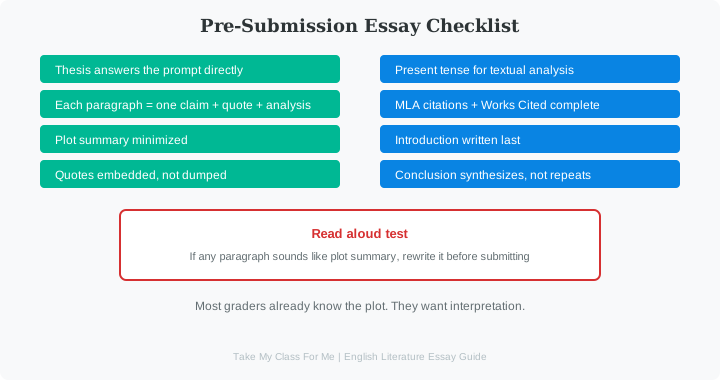
The thread connecting all seven? Students write about the text instead of writing through the text. Analysis lives in language, not plot events.
Tools and Resources for English Literature Essays
You don't need expensive software. You need the right free tools and one paid backup when deadlines collide.
Free academic resources:
- Humanities LibreTexts for literary theory primers and writing guides
- Purdue OWL MLA Guide for citation formatting
- JSTOR and Google Scholar for peer-reviewed secondary criticism
- SparkNotes Writing Help for basic structure refreshers (not as a citation source)
Professional organizations: The Modern Language Association (MLA) sets the citation standards your department expects. Most universities offer free writing center appointments where a tutor will review your thesis and one body paragraph in thirty minutes.
When to get help: If you're behind on reading and your deadline is within 48 hours, outsourcing comprehension and drafting support beats submitting a plot summary you'll regret. Take My Class For Me pairs students with literature tutors who know the texts on your syllabus and review drafts against real professor rubrics.
Putting It All Together
You started this guide staring at a blank document, probably behind on reading and worried about a field where English bachelor's degrees fell 43% from 2012 to 2024. That decline makes essay craft matter more, not less. Strong writers still stand out.
Here's what you now have:
- A three-tier reading triage system so impossible syllabi don't paralyze you
- A close reading workflow backed by research showing measurable comprehension gains
- The Observation + Analysis + Significance thesis formula with weak-to-strong examples
- PEEL body paragraphs with embedded quotes and word-level analysis
- A pre-submission checklist targeting the seven mistakes professors mark most often
I'll be honest: your first essay using this system won't be perfect. Mine weren't either when I started teaching this method fourteen years ago. But the students who improve fastest are the ones who revise one body paragraph at a time instead of trying to fix everything at once.
And the career case? The U.S. Bureau of Labor Statistics reports a median annual wage of $72,270 for writers and authors and $91,670 for technical writers as of May 2024. English graduates who write well don't just pass courses. They enter a job market that still pays for clear thinking on the page.
Your next step tonight: Open your current assignment's reading list. Spend ten minutes sorting it into Tier 1, 2, and 3. Then annotate one passage from a Tier 1 text using the Cornell method. That's your evidence bank started. One passage is enough to begin.
If you're facing a deadline you can't hit alone, get matched with an English literature tutor who can help you close-read the text and shape the argument before you submit.
![ProfHacker for Students: Productivity Tools Guide [2026]](system/images/thumbnails/profhacker-for-students-productivity-tools.svg)
![The Research Whisperer: Research Success Guide [2026]](system/images/thumbnails/the-research-whisperer.svg)
![The Thesis Whisperer: Thesis Writing Guide [2026]](system/images/thumbnails/the-thesis-whisperer.svg)