

Introduction
After ChatGPT launched in November 2022, college students cut their study time on AI-friendly ALEKS word problems by 26.9% over the next eleven quarters. That comes from a 2025 McGraw Hill and UC Irvine analysis of 3.2 million ALEKS learning interactions. The shortcuts feel faster. They are faster. And they still blow up in your face when a Knowledge Check arrives.
One student on r/college put the grind in plain terms: "I spent 2 hours yesterday and 7 hours today… and I STILL have 34 topics left out of 59!" When you're staring at a half-empty Pie chart at midnight, opening ChatGPT looks like the only move left. I've watched that play out in orientation labs and in the analytics dashboards I review for three state universities. The AI clears a topic. Two days later, a Knowledge Check strips it. Now you're behind, frustrated, and hunting for a bigger shortcut.
This guide is for students who searched "how to beat aleks by using ai" and want a straight answer. You won't find answer-bot tricks here. You'll get the attempt-consult-reattempt workflow that survives Knowledge Checks, a tool split for math vs chemistry, and the McGraw Hill retention data that explains why copy-paste AI fails. I've reviewed over 8,000 ALEKS Knowledge Check outcomes. Frankly, most guides stop at "use AI as a tutor" and never show you what that looks like on a stoichiometry problem with ALEKS formatting rules.
What Is ALEKS and Why Your AI Strategy Has to Match the Platform
ALEKS is McGraw Hill's adaptive learning platform that uses Knowledge Space Theory to map what you know, what you're ready to learn next, and what you've forgotten. Beating ALEKS with AI means building retained mastery that survives Knowledge Checks, not copying answers to clear topics faster.
That's the short answer search engines want. The longer answer is what separates students who finish the Pie from students who reset it every other week.
When you log in, ALEKS runs an initial knowledge check (usually 25 to 30 questions) and builds your mastery Pie. Each slice is a topic cluster: stoichiometry, logarithms, acid-base reactions, whatever your course covers. The system only unlocks topics your current knowledge state can support. Get one wrong, and ALEKS may route you backward. Master enough topics, and you'll get hit with a Knowledge Check that retests material from weeks ago. The McGraw Hill ALEKS implementation guide describes this as personalized learning paths driven by prerequisite relationships, not textbook chapter order.
Does the platform actually work when students engage honestly? A 2022-2023 Midwest district study published by McGraw Hill found ALEKS users passed state math tests at 57% compared to 40% for non-users across grades 6 through 11. That's not a small gap. At York University, a 2024 survey of 593 first-year math students found 51.61% rated ALEKS "very helpful" for overall learning. The platform isn't broken. The mismatch happens when students treat it like a checkbox and AI like a copy machine.
How Knowledge Space Theory Changes What "Beating" ALEKS Actually Means
Most students see the Pie chart. Few understand what's underneath it. Jean-Claude Falmagne and Jean-Paul Doignon developed Knowledge Space Theory in the early 1980s at UC Irvine and the Free University of Brussels. Their framework treats a subject as a set of problems with prerequisite links. Your "knowledge state" is the subset you can actually solve, not the subset you guessed through once with ChatGPT open in another tab.
Dr. Greg Dieckmann, a chemistry educator who presents on ALEKS for McGraw Hill, put it this way: "ALEKS uses Knowledge Space Theory and machine learning to build a clear picture of what each learner knows, without assumptions or labels." That 25-question initial knowledge check isn't random cruelty. It's triangulation. Every answer narrows which topics you've mastered and which you're ready to learn next.
Here's what the simple definition misses. Clearing a topic in learning mode is not the same as owning it. ALEKS stores both states separately. You can mark a topic mastered on Tuesday, fail it on a Knowledge Check on Friday, and watch it vanish from your Pie. An answer bot that types correct responses into the interface never builds the knowledge state the system will retest. It only borrows progress until verification catches up.

So how should you think about AI inside this system? Use it between ALEKS sessions to explain concepts, generate practice, and fix reasoning errors. Never use it as a substitute for the knowledge state ALEKS is tracking. Your AI strategy has to respect the verification loop, because the platform was built around it from day one.
How ALEKS and Generative AI Collided (And Why That Matters for You)
ALEKS didn't start as a homework headache. It started as a research project. Falmagne began building the system at UC Irvine in 1994 with National Science Foundation support, according to UC Irvine's 2013 research profile. The goal was personalized assessment that teaches, not a single score that ranks you. McGraw Hill acquired ALEKS in June 2013 for more than $100 million. By then the platform was already running in K-12 and higher ed, mapping individual learning paths instead of moving entire classes through the same chapter at the same pace.
For two decades, that model worked because the bottleneck was explanation, not answer delivery. If you got stuck on partial fractions, you clicked the ALEKS explanation, watched a video, or went to office hours. The platform's internal hints were often thin. Students complained. But the verification mechanism, Knowledge Checks, stayed consistent. Master topics during practice, prove retention later, or lose them.
Then came November 30, 2022. OpenAI released ChatGPT to the public. Within months, students had a free tutor that could explain stoichiometry at 2 a.m. in plain English. The Rismanchian study at UC Irvine and McGraw Hill tracked what happened next across millions of sessions. College students spent less time on text-based ALEKS problems that could be pasted into a chat window. High school students showed an even steeper drop: 31.3% less time cumulatively. Middle schoolers shifted less. Fifth graders showed no detectable change, which fits the pattern that younger students had less unsupervised AI access.
But here's the part that should stop you cold. On proctored retention items, the same research team found a 25% cumulative decline in the odds of a correct response linked to those shortcut study patterns. Less time on task. Less durable knowledge. ALEKS didn't change. The way students used AI did, and the platform's Knowledge Checks were already designed to expose the gap.
Universities are catching up on policy. UAB's Spring 2026 MA-102 syllabus bans ChatGPT, Copilot, Gemini, and Photomath on graded ALEKS assignments while explicitly allowing them "to assist in initial comprehension of new or difficult topics" outside graded work. That split is becoming the norm: AI for learning between sessions, zero AI during verification. If your professor hasn't posted a policy yet, ask. Don't assume.
Why does this history matter when you just want to finish your Pie? Because beating ALEKS with AI in 2026 isn't about finding a tool the platform can't detect. It's about using tools the platform can't replace. ChatGPT can't click graph sliders. Wolfram Alpha can't draw Lewis structures in ALEKS's chemistry editor. No bot can sit inside your account and survive a Knowledge Check you didn't actually learn for.
I'll be honest. This approach takes more discipline than pasting answers. It also takes less total time than the reset loop students fall into after every Knowledge Check wipe. The next section tackles the question you're probably already typing into another tab: can AI actually solve ALEKS problems? The answer is messier than yes or no, and the distinction determines whether you keep your progress.
Can AI Solve ALEKS?
Short answer: AI can solve isolated math problems in a chat window. It cannot reliably complete ALEKS for you. The platform's interactive interface, randomized values, strict formatting rules, and Knowledge Check verification loop defeat copy-paste shortcuts almost every time.
Students keep asking anyway. "Why can't I just use ChatGPT or Photomath for ALEKS?" shows up constantly on r/college and homework help forums. I've seen the same pattern in analytics dashboards for three universities: a student clears five topics in one night with AI open, then loses four of them on the next Knowledge Check. The math in chat was often correct. The knowledge state ALEKS tracks was not.
A 2025 study by Rismanchian and colleagues at UC Irvine and McGraw Hill analyzed 3.2 million ALEKS learning interactions over a decade. Their team split problems into AI-susceptible types (text word problems you can paste into ChatGPT) and AI-resistant types (graph-based problems requiring on-screen manipulation). After ChatGPT's November 2022 launch, college students spent 26.9% less time on the susceptible problems. Graph problems stayed flat. That tells you exactly where AI "works" and where it doesn't.
Where ChatGPT Works on ALEKS (and Where It Breaks)
ChatGPT shines when you rephrase an ALEKS topic as a concept question. "Explain how to find the slope from two points, step by step, like I'm rusty on algebra" gets you a useful tutor response at 11 p.m. when your professor's office hours ended six hours ago. It can generate practice problems similar to your current Pie slice. It can review your handwritten work if you describe your steps without copying the exact ALEKS prompt.
Where it breaks is everything ALEKS actually grades. ChatGPT is blind to the screen. It cannot see graph sliders, dropdown menus, drag-and-drop number lines, or the chemistry structure editor where you place atoms and bonds. The OpenAI developer community has active threads from users reporting incorrect answers on graph-based math problems because the model cannot reliably interpret visual layout from screenshots.
Formatting kills more submissions than wrong math. ChatGPT might tell you x = 2.5 when ALEKS wants 5/2. It might give 0.667 when the platform demands exact fractions. In chemistry, subscripts, charges, and significant figures all have rules ALEKS enforces that a language model does not know unless you describe them, and most students don't know them either until the answer marks wrong.
Take a typical College Algebra topic: identifying the vertex of a parabola from a graph displayed on screen. You'd need to read the plotted curve, possibly drag a point, and enter coordinates in a specific format. ChatGPT never sees that graph. A student at UW-Milwaukee told the campus paper in 2016 that ALEKS made her feel "more unconfident than when I'm giving answers on that program." AI shortcuts amplify that feeling when the chat says you're right and ALEKS says you're wrong.
Why Wolfram Alpha and Photomath Are Not ALEKS Shortcuts
Wolfram Alpha is a computational engine, not a chatbot. It calculates precisely. A 2024 Academia Stack Exchange thread among faculty and grad students put the distinction bluntly: ChatGPT "is Russian roulette" for students without a solid conceptual base because hallucinated math looks convincing. Wolfram gives verifiable answers but still cannot click ALEKS widgets or know which format the platform expects for a given problem instance.
Photomath and Microsoft Math Solver work on photographed equations. ALEKS randomizes values per student session, so static answer databases miss constantly. And photographing your screen may violate your course policy even when the math itself is fine.
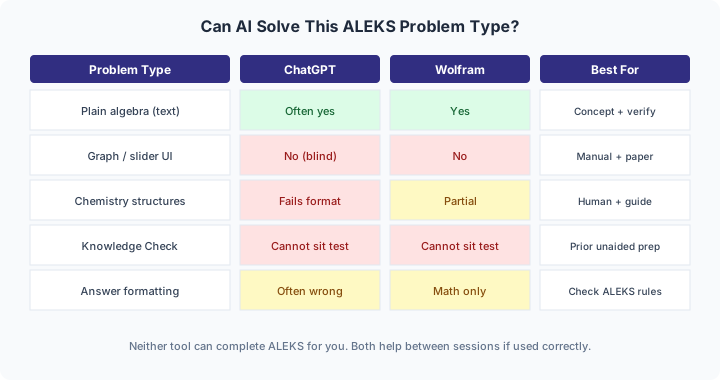
| Tool | Strength on ALEKS | Hard Limit | When to Use |
|---|---|---|---|
| ChatGPT / Claude | Concept explanations, Socratic tutoring, practice generation | Blind to interface; arithmetic errors; wrong formats | Between sessions, after solo attempt |
| Wolfram Alpha | Exact computation, calculus steps, verification | No graph UI; no chemistry structure input | After your own attempt, to check method |
| Photomath | Photo-based step breakdowns | Cannot see randomized ALEKS instances | Offline practice only, not live ALEKS |
So can ChatGPT solve ALEKS problems? Sometimes in isolation. Can it beat ALEKS? No. Not if beating means keeping your Pie progress through verification. The platform was designed to test what you retain, not what you pasted.
How ALEKS Knowledge Checks Defeat Copy-Paste AI
If there's one mechanism that ends AI shortcut fantasies, it's the Knowledge Check. You can fake your way through practice problems with ChatGPT whispering in your ear. You cannot fake a Knowledge Check that retests topics you "mastered" three weeks ago without warning.
A student on r/college described the whiplash perfectly: "I'm so tired of sitting down and getting halfway through my homework, having a realistic idea of when I'll be done, and then getting interrupted with 'here's a little exam over everything you've learned.' My workload pretty much just doubled." That interruption isn't a bug. It's the core verification design.
What Triggers a Knowledge Check and What Gets Reset
Knowledge Checks appear after you've mastered roughly 15 to 20 topics, after periods of inactivity, or before major exams depending on your instructor's settings. Each check pulls 20 to 30 questions from your learned material, often emphasizing topics you haven't touched in three to four weeks. Perform well and your mastery holds. Miss enough and ALEKS downgrades topics from "mastered" back to "learned" or removes them entirely.
This is where borrowed AI progress collapses. The Rismanchian team's 2025 analysis found a 25% cumulative decline in the odds of correct responses on proctored retention items linked to shortcut study on AI-susceptible problems. Students spent less time learning. They retained less. ALEKS Knowledge Checks surface that gap without needing to spy on your browser tabs.
Instructors see more than you think. McGraw Hill's ALEKS Insights reports flag failed topics, decreased learning, unusual pacing, and procrastination patterns. Knowledge Check regression, where practice scores look strong but check scores crater, is the clearest signal that outside help built performance without building knowledge. I've flagged that pattern in faculty training sessions. Professors aren't always hunting for cheaters. They're doing routine progress reviews and the data makes the story obvious.
Why does ALEKS reset your progress after you used AI? Because the Knowledge Check discovered you cannot reproduce understanding independently. The topics you cleared with copied answers were never in your knowledge state. They were rented.
Your defense is boring and effective. Before each study block, spend 15 minutes reviewing your 10 oldest mastered topics with zero AI open. That simulates what a Knowledge Check feels like and exposes gaps while you still have time to fix them. One fully unaided review session per week does more for retention than an hour of ChatGPT explanations.
The Attempt-Consult-Reattempt Workflow (Step by Step)
To beat ALEKS by using AI, treat ChatGPT and Claude as tutors not answer machines. Attempt each problem solo first, ask AI to explain the reasoning behind the method, close the tool, then re-solve the problem yourself before submitting. This builds mastery that survives Knowledge Checks.
That's the workflow search engines should surface. Here's how to run it in a real study session. Old Dominion University's 2021 research on ALEKS and self-regulated learning found a significant decline in student SRL scores over a semester using the platform alone. Students cited frustration, hard penalties, and thin explanations. Structured external tutoring, including ethical AI use with reflection steps, rebuilds the planning and self-checking habits that shortcuts destroy.
Step 1: Attempt Solo (10-15 Minutes)
Open ALEKS only. No ChatGPT tab. No Wolfram. Work on paper for every problem, even if ALEKS provides an on-screen keypad. Write the given information, name what you're solving for, and attempt a full solution. If you stall, note the exact step where your reasoning breaks. "I don't know what to do" is too vague. "I got lost when I had to convert moles to grams" is actionable.
Give yourself two genuine wrong attempts before you're allowed to consult AI. ALEKS's own mastery bar expects struggle. Skipping straight to hints or external tools trains you to reach for help before your brain engages. A 2025 randomized study by Bastani and colleagues found unrestricted GPT-4 access during math practice improved assisted scores by 48% but reduced unassisted exam performance by 17%. The assistance felt like learning. The exam proved otherwise.
Step 2: Consult AI for Concept, Not Answer
Close ALEKS or minimize it. Open ChatGPT or Claude in a separate window. Ask about the concept behind your stuck point, not the specific problem. Example: "I'm working on limiting reactants in stoichiometry. I keep picking the wrong reactant to run out first. Walk me through how to decide, using a simple non-numeric example first."
If the first explanation doesn't click, ask for a different angle. "Explain it with a cooking analogy" or "show me the wrong way students usually set it up and why it fails." Socratic back-and-forth beats a single dumped solution every time. Never ask "what is the answer." Ask "is my reasoning on step 3 correct, and if not, what rule did I violate?"
Step 3: Reattempt and Submit Unaided
Close the AI tool completely. Not minimized. Closed. Return to ALEKS and solve the problem from a blank page. If you can't do it without peeking, you didn't learn it. You received a lecture. Go back to Step 2 with a narrower question, then try again.
Before you click submit, say your steps out loud or explain them in a sentence on paper. ALEKS doesn't hear you, but the act exposes gaps you'd otherwise miss. Match the platform's format carefully: fractions vs decimals, units, significant figures in chemistry, simplified vs unsimplified expressions.
Step 4: Verify Computation (After Your Attempt)
Use Wolfram Alpha only after Steps 1 through 3. Plug in your expression to check arithmetic or see where your manual work diverged. Wolfram is a diagnostic, not a starting point. If Wolfram says 5/2 and you entered 2.5, you found a formatting issue, not a math issue.
Step 5: Prep for Knowledge Checks Weekly
Schedule one unaided review session per week. Reattempt recent topics and your oldest mastered slices with no AI. This is the closest rehearsal for what ALEKS will do to you without warning. Students who skip this step are the ones posting about progress resets on Reddit.
Bundle these steps into 25 to 40 minute blocks. Three blocks per week on thin Pie slices beat one six-hour marathon that triggers lockouts and shallow retention. End each block by writing three sentences in your own words summarizing what you learned. That active recall step moves understanding from short-term memory into something a Knowledge Check can actually test.
How do you use AI on ALEKS without cheating? This workflow is the line. AI explains between attempts. You prove understanding inside ALEKS. The next section breaks down which tools fit math vs chemistry so you're not reaching for the wrong one.
Best AI Tools for ALEKS Math vs Chemistry
You now know the workflow. Here's which tools fit which job. Frankly, using ChatGPT for everything is how students waste an hour and still submit wrong formatted answers. Match the tool to the task and you'll cut consult time in half.
Math Tool Stack: ChatGPT, Claude, Wolfram Alpha, Mathway
ChatGPT or Claude own concept explanation. Logarithm rules, partial fractions, function transformations, word problem setup. Ask for Socratic questioning, not solutions. OpenAI's Study Mode (rolled out in 2025) asks guiding questions instead of dumping answers, which aligns with how ALEKS actually tests you.
Wolfram Alpha owns verification after your attempt. It computes precisely. A 2024 Academia Stack Exchange thread among faculty warned that ChatGPT without verification is "Russian roulette" for students who lack a solid base. Wolfram is the calculator you use to catch sign errors and fraction mistakes, not the tutor you open first.
Mathway sits between them for algebra through calculus step breakdowns. Use it offline on practice problems you generated in chat, not on live ALEKS screens.
Graph problems break every text-based tool. Sketch the graph on paper first. Label intercepts and slope yourself. Then ask AI to check your reasoning from a written description. The model still cannot click ALEKS sliders for you.
Chemistry Tool Stack: Where AI Stops and Human Help Starts
Chemistry is harder for AI on ALEKS than math. A 2021 MDPI study of 120 introductory chemistry students found only 47% felt ALEKS supported their learning while 53% were dissatisfied, often citing complexity and penalty systems. Those frustrated students are exactly who reach for ChatGPT. It helps with concept explanations. It fails on Lewis structures, VSEPR drawings, molecular geometry inputs, and subscript formatting inside ALEKS's editor.
Use AI to explain mole ratios, equilibrium intuition, and acid-base theory in plain language. Do not ask it to draw your structure in the ALEKS canvas. For stoichiometry, work on paper, verify arithmetic with Wolfram, then enter carefully. Our ALEKS chemistry study guide covers topic-specific traps AI cannot see from a chat window.
| Task | Best Tool | ALEKS Limitation | When to Use |
|---|---|---|---|
| Concept explanation | ChatGPT / Claude | Cannot see problem UI | After 2 failed solo attempts |
| Arithmetic verification | Wolfram Alpha | Wrong format still marks wrong | After your own solution attempt |
| Spaced repetition | Anki / Quizlet | Not integrated with ALEKS | After mastering a Pie slice |
| Structure drawing | None (AI) | Requires ALEKS editor | Office hours or tutor |
Copy-Ready AI Prompts That Actually Work on ALEKS Topics
Bad prompts get bad answers. Here are five you can paste today. Swap the bracketed text for your topic.
Concept explainer (use first): "Teach me [topic] using the Socratic method. Do not give final answers. Ask me one question at a time. If I answer wrong, show me where my reasoning broke. Use a simple analogy after the second wrong attempt."
Bad vs good error analysis:
Bad: "What is the answer to this problem?"
Good: "Here are my steps for [describe process without copying
exact ALEKS text]. I got [your answer]. ALEKS marked it wrong.
Which step likely violated formatting or logic, and what rule
should I review?"
Practice generator: "Generate 5 practice problems on [topic] at [easy/medium/hard] difficulty. Do not solve them. After I submit my work for problem 1, grade my reasoning only and ask a follow-up if I missed a concept."
Knowledge Check prep: "Quiz me on [list 8 topics from oldest mastered slice]. Ask one question at a time. Wait for my answer before revealing whether I was right. No hints unless I ask."
Weekly review: "I finished these ALEKS topics this week: [list]. For each, give me one likely Knowledge Check trap question and explain the misconception behind it. Do not give answers until I attempt each."
7-Day ALEKS + AI Study Schedule
Structure beats motivation when ALEKS is your third priority behind two other classes. York University's 2024 ALEKS survey found students who rated the platform "very helpful" tended to work in consistent sessions, not random midnight binges. This schedule mirrors what I assign in orientation workshops.
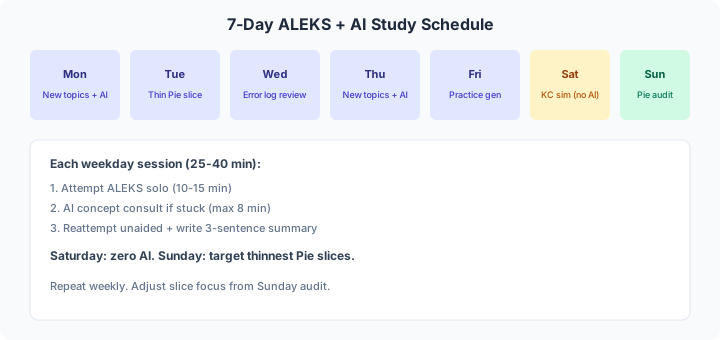
| Day | Focus | AI Allowed? | Duration |
|---|---|---|---|
| Monday | New topics from thinnest Pie slice | Yes, after solo attempt | 2 x 30 min |
| Tuesday | Continue same slice until 3 topics mastered | Yes, consult only | 1 x 35 min |
| Wednesday | Review error log from Mon-Tue | Yes, explain mistakes | 1 x 25 min |
| Thursday | Second thinnest slice | Yes, after solo attempt | 2 x 30 min |
| Friday | AI-generated practice set offline | Yes, then redo unaided | 1 x 40 min |
| Saturday | Knowledge Check simulation | No AI | 1 x 45 min |
| Sunday | Pie audit + plan next week | No AI | 20 min |
Common Mistakes When Using AI on ALEKS
These are not theoretical. They're the patterns I see in analytics dashboards and the posts students leave on r/college when their Pie resets. The University of Louisiana's online learning team lists over-reliance and skipping verification as top AI mistakes in coursework. Same story here, with ALEKS-specific teeth.
Mistake 1: Copy-pasting answers without understanding. Topics clear fast. Knowledge Checks strip them faster. The 2025 Rismanchian study linked shortcut study to a 25% drop in proctored retention odds. Fix: attempt-consult-reattempt every time, no exceptions.
Mistake 2: Using AI during an active Knowledge Check. Even if your professor does not proctor the screen, you're proving nothing to the system and violating academic integrity at most schools. Fix: AI is for between sessions only.
Mistake 3: Skipping paper work on graph and chemistry problems. UL Lafayette's AI guidance stresses that tools predict text, not spatial reasoning. Fix: draw first, describe to AI second, enter in ALEKS third.
Mistake 4: Browser automation scripts and answer bots. Inhuman click timing, inability to handle dropdowns, and detectable injection patterns. Fix: there is no reliable bot. Use the tutor workflow or get human help on interface-specific tasks.
Mistake 5: Never practicing unaided until ALEKS forces it. Reddit's "workload just doubled" Knowledge Check posts come from students who treated practice as optional. Fix: Saturday simulation, every week.
The thread connecting all five? Treating AI as a completion tool instead of a comprehension tool. ALEKS was built to punish that confusion.
Does ALEKS Detect AI?
ALEKS does not read your ChatGPT tabs, but it detects inconsistent learning through Knowledge Check regression, response timing patterns, and instructor Insights reports. The platform is designed to verify mastery independently, which is why borrowed AI answers fail on the next assessment.
Does ALEKS detect AI or cheating directly? Not like plagiarism software scanning your browser. It detects patterns inconsistent with genuine learning. Strong practice performance plus crashing Knowledge Checks is the signature. Instructors reviewing ALEKS Insights see failed topics, decreased learning velocity, and unusual pacing. A professor doing routine progress review can spot the gap without ever seeing your screen.
What Instructors Actually See on the ALEKS Insights Dashboard
Insights groups student data into four learning categories with actionable flags. Decreased learning and unusual learning patterns often correlate with students who cleared topics quickly but cannot retain them. Time-per-question averages that swing from 90 seconds to 8 seconds on similar problem types also raise eyebrows, especially when paired with KC regression.
If your course uses Respondus or Honorlock, screen recording and tab monitoring add another layer during proctored placement tests. UAB's Spring 2026 syllabus bans AI on graded ALEKS work outright while allowing it for comprehension outside graded sessions. Know which mode you're in before you open a chat window.
Is Using AI for ALEKS Cheating?
It depends on how and when you use it. Using ChatGPT to explain stoichiometry at midnight before you attempt problems tomorrow is study support at most schools. Pasting AI answers into a graded Knowledge Check or proctored placement test is academic misconduct at nearly all of them.
UAB's MA-102 quantitative literacy syllabus draws a line many institutions are copying: AI tools are prohibited on graded ALEKS assignments but encouraged "to assist in initial comprehension of new or difficult topics" for non-graded practice. Harvard's Graduate School of Education similarly allows brainstorming with disclosure while banning submitted AI-generated work. The ethical test is simple: could you pass a surprise unaided quiz on the same topic tomorrow? If no, you cheated yourself even if you didn't cheat the policy.
Essential ALEKS and AI Resources
Official ALEKS support: The McGraw Hill ALEKS Support Center covers Knowledge Checks, Pie progress, and instructor reports. Start here when the platform behavior confuses you.
Free math and chemistry content: OpenStax textbooks pair well with AI tutoring because you can ask ChatGPT to explain a specific OpenStax section by name. LibreTexts Chemistry fills gaps ALEKS explanations skip.
Research and policy: The Rismanchian et al. study on generative AI and ALEKS learning outcomes (UC Irvine and McGraw Hill, 2025) is worth reading if you want to understand why shortcuts backfire. ERIC hosts peer-reviewed ALEKS placement efficacy studies showing accurate placement predicts calculus success better than guessing your level from a SAT score alone.
Our guides: Pair this article with our ALEKS math study guide and ALEKS chemistry study guide for topic-level depth AI cannot replace.
When AI is not enough: Interface-specific problems (graph clicks, structure drawing, proctored placement) need a human who works inside ALEKS. That's where Take My Class For Me connects you with tutors who understand the platform mechanics, not just the math behind them.
The Real Win: Growing Through ALEKS, Not Gaming It
You started this article after reading that college students cut ALEKS study time by 26.9% using AI shortcuts, and that those shortcuts came with a 25% retention penalty when the platform tested them for real. That trade is the whole story in two numbers.
Here's what you now have:
- A clear answer on whether AI can solve ALEKS (partially in chat, not on the platform)
- The attempt-consult-reattempt workflow that survives Knowledge Checks
- A math vs chemistry tool matrix so you're not using ChatGPT for Lewis structures
- Copy-ready prompts that ask for understanding, not answers
- A 7-day schedule with a weekly unaided simulation built in
Beating ALEKS with AI in 2026 is not about hiding from the system. It's about learning faster between verification events so the system stops resetting your progress. A 2024 SDSU study in PRIMUS found ALEKS PPL scores were a strong predictor of calculus success when students actually built the knowledge behind the score. Your Pie chart works the same way. The percentage means nothing if a Knowledge Check proves it was borrowed.
Here's your next step tonight: pick your thinnest Pie slice, set a 12-minute solo timer, and only then open ChatGPT with the Socratic tutor prompt from this guide. One topic done right beats five topics cleared with copied answers.
And if you're stuck on a problem type AI genuinely cannot touch, reach out for ALEKS help. Sometimes the fastest path through the platform is a human who has clicked the same dropdown a thousand times.
![ALEKS Math Study Guide: Complete Prep Guide [2026]](system/images/thumbnails/aleks-math-study-guide.svg)
![ALEKS Chemistry Study Guide: The Complete Prep Guide [2026]](system/images/thumbnails/aleks-chemistry-study-guide.svg)
![Principles of Biology II: Complete Prep Guide [2026]](system/images/thumbnails/principles-of-biology-ii-study-guide.svg)